
6 October 2026
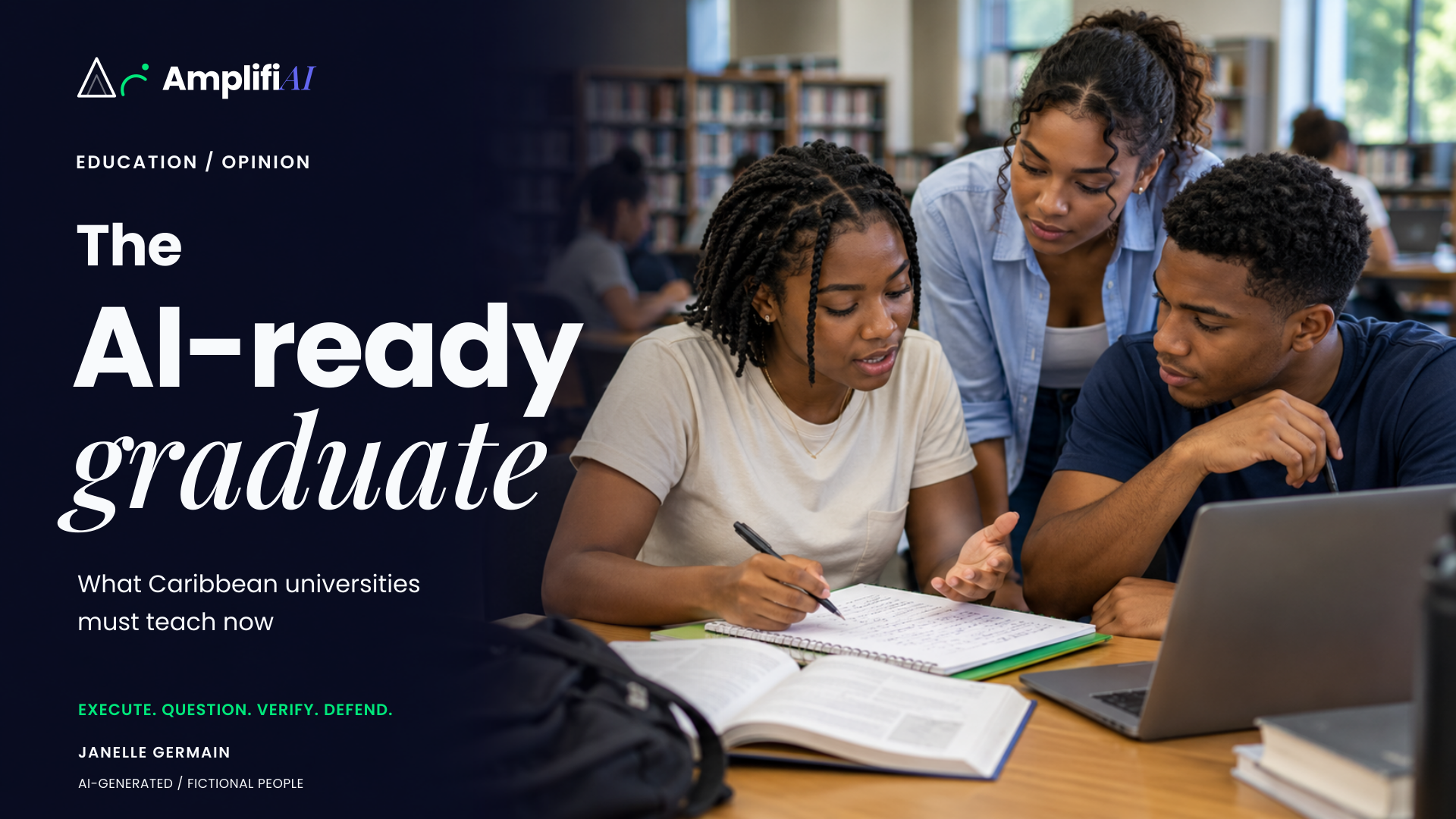
The AI-ready graduate: what Caribbean universities must teach now
By Janelle Germain · Founder, Amplifi AI · October 6, 2026 A student can follow every rule about AI disclosure and still leave university unprepared for work. They may acknowledge the tool, submit a polished assignment and satisfy the marking criteria. Then they enter a workplace where someone asks them to explain the recommendation, check the figures or adapt the plan, and the understanding is missing. That is the challenge Caribbean universities and schools need to address. Academic integrity belongs within that responsibility. It cannot carry the whole strategy. The graduate standard: our response to AI should prepare students to produce work they understand, verify and can defend.
What should an AI-ready graduate be able to do?
Imagine a graduate joining a Caribbean business where a small team handles research, proposals, customer communication and delivery. AI may help them prepare a response quickly. The business still needs someone who can judge whether it is ready to use. Is the information current? Does the price make sense? Can the company deliver what the draft promises? What evidence supports the recommendation? When should the work pause for a more experienced person to review it? Those questions require subject knowledge. A student needs to understand enough of their discipline to recognise a weak assumption, investigate an unfamiliar claim and explain a decision. I want our institutions to make those capabilities explicit in programme design. Graduates should leave with practice completing real work, including the checking and revision that make it credible. UWI's publicly available AI Policy Framework addresses AI-aware programmes, staff development and assessment revision. It provides a useful regional reference. The next question is how those intentions become visible in assignments, teaching and student capability.
Make students show how the answer holds up
Consider an illustrative marketing assignment for a Caribbean food business. Give students a fixed budget, limited production capacity, an approved dataset and a clear commercial objective. Allow AI-assisted research and drafting where appropriate. Put the recommendation under pressure: What evidence supports the chosen audience? Does the budget add up? Can the business fulfil the offer? Which recommendation did the student reject, and why? What new information would change the plan? Partway through the exercise, reduce the budget or change the delivery constraint. Ask students to revise their recommendation and explain the trade-off. That gives the lecturer something more revealing than a finished document. It shows whether the student understands the problem and can respond when the conditions change. TEQSA's assessment-reform guidance supports programme-level design and multiple ways of establishing learning. Drafts, practical work, oral explanations, feedback and documented revisions can build evidence across a course of study. One submission should not have to prove everything. There will still be foundational skills students should demonstrate without assistance. Those assessments need a clear educational purpose and a place within a programme that also teaches responsible AI use.
Teach verification as a working habit
Students need practice finding the problem in an answer that initially looks convincing. Include an invented citation, an outdated statistic or a calculation built on the wrong assumption. Give them a recommendation that ignores the business's capacity. Ask them to identify the weakness, locate reliable evidence and explain the correction. The point is to develop a habit they can carry into work: pause, examine the claim, check the source and decide whether the answer deserves to be used. A prompt history alone cannot establish that understanding. Students should be able to explain what they accepted, what they changed and what they remain uncertain about.
Make access part of the design
A paid subscription, a newer device or stronger connectivity can give one student an advantage that remains invisible in the marking scheme. Institutions need to address that before setting the assignment. Provide approved tools or an equivalent route to the learning outcomes. Protect student information. Make disclosure expectations clear. Schools also need age-appropriate approaches. Younger learners can compare explanations and question sources through teacher-led activities. Older students can practise verification and disclosure in supervised projects using approved tools. The learning objective should determine the activity.
Give educators room to make the change
Teachers and lecturers need protected time to redesign assignments, test tools and agree on what sound judgment looks like in their subject. They need manageable assessment methods and accessible alternatives for students who face barriers. A policy asking staff to integrate AI, added to an unchanged workload, is an inadequate implementation plan.
Your next step: bring one assignment. Redesign it. Test it.
At your next faculty or school leadership discussion, bring one real assignment and ask: What would convince us that this student understands the work, can use AI responsibly and can defend the result? 1. Identify the reasoning, checks and practical skills the student must demonstrate. 2. Redesign the brief and marking criteria to make that evidence visible. 3. Test the revised assignment against a changed constraint and review what it reveals. Our graduates should be able to think, execute, verify and adapt. Education needs to give them repeated opportunities to develop those capabilities before the responsibility becomes real.
Editorial source note
UWI AI Policy Framework: https://www.uwi.edu/obus/sites/obus/files/tmp/UWI%20AI%20Policy%20Framework.pdf TEQSA assessment-reform guidance: https://www.teqsa.gov.au/sites/default/files/2023-09/assessment-reform-age-artificial-intelligence-discussion-paper.pdf Janelle Germain is the founder of Amplifi AI and writes the Caribbean AI Brief.
Practical AI training for Caribbean professionals and teams, built around real work.
Explore Amplifi Academy trainingFAQ
Frequently asked
- What is an AI-ready graduate?
- A graduate who can think, execute, verify and defend their work: someone with enough subject knowledge to recognise a weak assumption, check an AI-assisted answer against reliable evidence and explain the decision behind it.
- Is this an argument against AI disclosure rules?
- No. Academic integrity belongs within the responsibility of universities, but it cannot carry the whole strategy. A student can follow every disclosure rule and still leave unprepared to judge whether AI-assisted work is ready to use.
- What should Caribbean universities change first?
- Bring one real assignment to the next faculty discussion and ask what would convince you the student understands the work, can use AI responsibly and can defend the result. Then redesign the brief and marking criteria to make that evidence visible.