
3 September 2026
One Radio Segment Beat My Entire Digital Ad Spend
By Janelle Germain · Founder, Amplifi AI · September 3, 2026 My digital ads did exactly what the dashboards said they would do. They delivered impressions. They reached the audiences I selected. The reporting was clean. They did not deliver much business. Then I went live on VOB. One segment brought Amplifi AI more business than all the digital advertising I had paid for up to that point. That is not a slogan. It is an accounting result. And for someone who has spent a career in digital marketing, it was uncomfortable. At first, I thought this was a story about radio. It is not. It is a story about what happens when the cost of looking credible collapses, while the cost of earning credibility does not.
The new scarcity is not content. It is credible proof.
AI has made it possible for almost any business to create polished content at extraordinary speed. Websites, articles, campaign concepts, case-study layouts, images and video can all be produced faster and more cheaply than they could a few years ago. That is useful. It is also changing how buyers interpret what they see. A 2026 YouGov and Meltwater study of nearly 10,000 people across seven countries found that 86% think it is important for content to state explicitly when AI was involved, and 59% said a lack of disclosure reduces their trust in a brand outright. When respondents were asked how knowing that content was AI-generated would affect their trust in a brand, 32% said they would trust the brand less, while 15% said more. These are global figures, not Barbados-specific data, and they do not show that people reject AI. They show something more useful: AI can increase output while weakening trust when it obscures the source of a claim, feels deceptive or removes visible human judgment. Research from the Nuremberg Institute for Market Decisions points in the same direction. Their study, Transparency Without Trust, found that simply labelling an advertisement as AI-generated led people to judge it as less natural and less useful, which lowered their attitude toward the ad and their willingness to research or buy. The penalty was smaller for innovative, high-technology products and larger for traditional ones, and smaller among people who already held high general trust in AI. The advertisement itself had not changed. The label had. And the study's own conclusion is the sharper point for marketers. Transparency alone did not repair the trust. Disclosure is necessary. It is not sufficient. That is the shift businesses need to understand. We are not entering a world in which quality no longer matters. We are entering a world in which quality, by itself, no longer proves very much.
What radio gave me that the ads could not
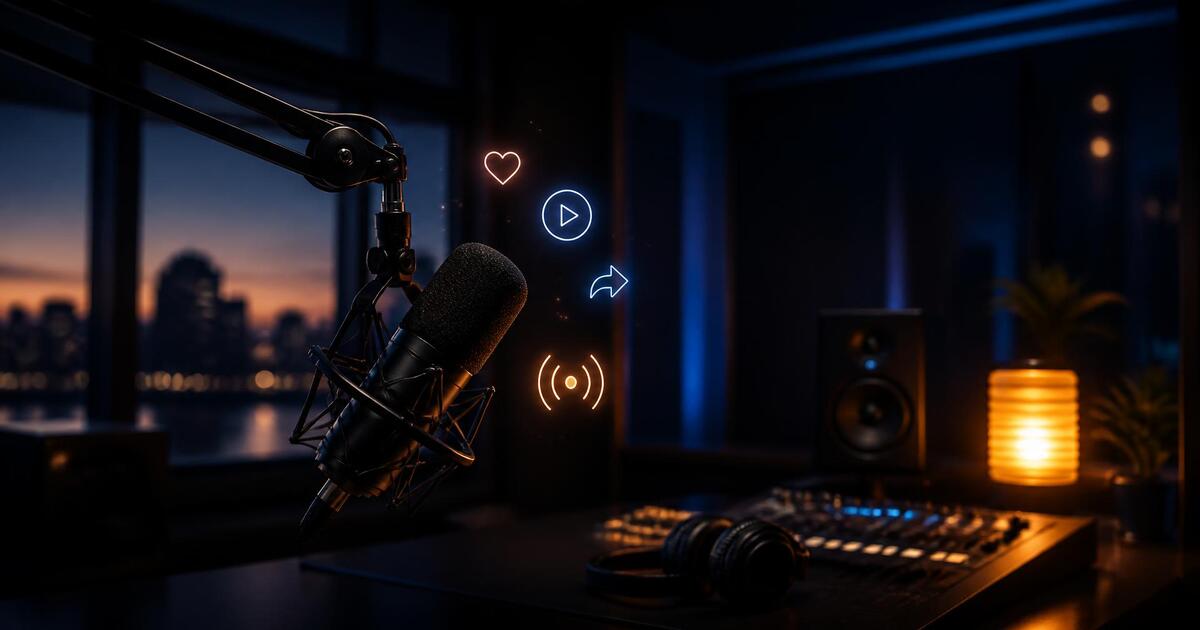
The radio segment carried three things my ads did not: identity, stakes and the possibility of challenge. I was physically present in a studio, speaking live. A host with a reputation of his own had chosen to put me on air. A question could come that I had not anticipated. If I answered badly, I could not edit myself into competence afterwards. Listeners were not merely hearing me describe my expertise. They were hearing whether I could think. That is why a voice arriving in your car at half past seven can feel different from a polished video arriving in your feed late at night. One has an immediate human context. One has a witness. The ads had targeting. The segment had consequence. My digital spend bought the opportunity to be seen. The radio segment created the opportunity to be believed. That does not mean digital is dead, or that radio will outperform paid media for every business. One company result is not a universal media law. But it does expose a mistake many of us are making: we are asking paid media to manufacture trust when paid media can only distribute a message. Creative can earn attention. It cannot, by itself, solve a credibility problem.
Service businesses now have a proof problem
If you sell a physical product, the object carries some of the evidence. A customer can inspect it, hold it, taste it, try it, return it or compare it with another product. A service is different. Before the work begins, the customer is buying a future outcome. Consulting, training, accounting, legal work, design, construction, coaching, repairs and catering all require someone to believe a promise before the full evidence exists. For years, service businesses reduced that uncertainty through proxies: the polished website, the testimonial, the case study, the client-logo wall, the professional photograph, the thoughtful article and the before-and-after. Those signals are not worthless. But they are no longer sufficient on their own, because the cost of producing them, and of simulating them, has fallen sharply. A buyer does not have to decide that your evidence is false. They only have to know that it could be. Once that possibility becomes cheap and common, people begin to discount the signal. Not because they no longer care about expertise, but because the instruments we have used to transmit expertise have become noisier. That is the real crisis in service marketing now. It is not a shortage of content. It is a shortage of proof that carries enough consequence to be believed.
The Interruption Test
I now ask one question about every marketing format I use: Can this be interrupted? By “interrupted,” I do not mean commented on after publication. I mean challenged while competence is being demonstrated, before the outcome can be edited into shape. A written post is complete before the reader sees it. A live interview is still being made in front of the audience. A recorded demonstration can be cut around the weak moments. A live audit can expose the exact point at which the expert does not know what to do. A case study can present the clean version of a project. A workshop allows someone to bring the messy version of their own problem and ask you to deal with it in real time. The possibility of interruption matters because it introduces accountability. A real person owns the claim. Something is at stake if the claim fails. Someone else has the opportunity to test it. Risk is not the goal. Accountability is. For a service business, that accountability is the product demonstration. Anyone can publish a claim to expertise. Far fewer people will stand somewhere the claim can be examined.
Do not abandon digital. Change what digital carries.
The wrong conclusion from my result would be: stop advertising online and put everything into radio. The better conclusion is this: create proof in high-accountability environments, then use digital to distribute it. Go on air, then turn the strongest exchange into a clip. Teach the workshop, then publish the hardest question you received and how you answered it. Run a live audit, then turn the reasoning into an article. Show the real process, including the constraints, decisions and trade-offs, not only the polished result. Let a client speak in a context where their identity and experience can be verified. Radio can originate trust. LinkedIn can spread it. Your website can archive it. Email can deepen it. Digital is not the enemy. Unwitnessed perfection is the problem. Some of the strongest digital content will now be evidence that something real happened somewhere else.
The Caribbean has an advantage here
Small markets are often discussed as though their limited scale is only a disadvantage. But small markets also have dense reputation networks. In my experience of Barbados and the wider Caribbean, a credible interaction can travel quickly through overlapping professional and personal relationships. Someone who heard you answer a difficult question may work with your next client, know your next client or be asked about you before the client ever contacts you. Word of mouth is not simply another promotional channel in that environment. It is the verification layer. One room does not need to reach everyone. It needs to reach people who will carry a witnessed experience into the next conversation. Modern marketing taught us to dismiss anything that did not scale. But in an era of synthetic abundance, the things that do not scale cheaply may become more valuable precisely because they are harder to fabricate cheaply. It does not scale. That is why it works.
Where AI belongs, from someone who sells it
This is not an anti-AI argument. I train companies to use AI for a living. AI helped me prepare for the radio segment. It helped me organise the argument, pressure-test the positions I was taking, anticipate difficult questions and sharpen my answers. It made me faster and better prepared. What it did not do was sit in the studio. It did not lend its reputation to the claim. It did not take an unexpected question. It did not have anything to lose if the answer failed. That is the line I would draw for every service business: Use AI backstage. Keep accountability onstage. Use AI to research, structure, analyse, prepare, follow up and serve customers better. Do not use it to erase the person who is responsible for the promise. The winning model is not human versus AI. It is AI-amplified human proof. AI should make your people more capable. It should not make your company feel as though no people are there.
The question every service business should ask now
Do not begin with: How much more content can we make? Begin with: Where can customers watch us think? Where can they question us? Where can they see how we respond when the problem is incomplete, inconvenient or difficult? What can we demonstrate that would be hard for an inexperienced competitor to simulate? Then use AI to prepare for that moment. Use digital to carry it further. But let a real person stand behind the promise. Get in the room. Get on the air. Show the work. Take the questions. Because the next marketing advantage may not be louder marketing. It may be marketing with consequences.
Editorial source note
The international research cited above is directional rather than Barbados-specific: YouGov and Meltwater, Trust in the Age of Generative AI (published April 2026, fielded February to March 2026), based on a survey of nearly 10,000 respondents across Australia, Canada, France, Germany, Singapore, the United Kingdom and the United States. Nuremberg Institute for Market Decisions, Transparency Without Trust: The Impact of Consumer Skepticism of AI-Generated Marketing Content (2025). Reuters Institute, Digital News Report 2026 and Journalism, Media and Technology Trends and Predictions 2026, for the broader shift toward platform-based consumption alongside increasing trust and misinformation concerns. Janelle Germain is the founder of Amplifi AI and writes the Caribbean AI Brief.
Build capability without losing trust. Amplifi AI helps Caribbean organisations use AI to improve how their teams think, work and serve, while keeping human judgment and accountability visible.
Explore AI TrainingFAQ
Frequently asked
- Can radio really outperform digital advertising?
- For Amplifi AI it did: one live segment generated more business than all prior paid digital spend. That is one company's result, not a universal media law — the lesson is that high-accountability formats build trust that paid reach alone cannot manufacture.
- What is the Interruption Test?
- A simple question for any marketing format: can this be interrupted — challenged while competence is being demonstrated, before the outcome can be edited into shape? Formats that allow live challenge carry accountability, and accountability is what buyers now trust.
- Does this mean businesses should stop using AI in marketing?
- No. Use AI backstage for research, structure, analysis and preparation — but keep accountability onstage. The winning model is AI-amplified human proof, not human versus AI.